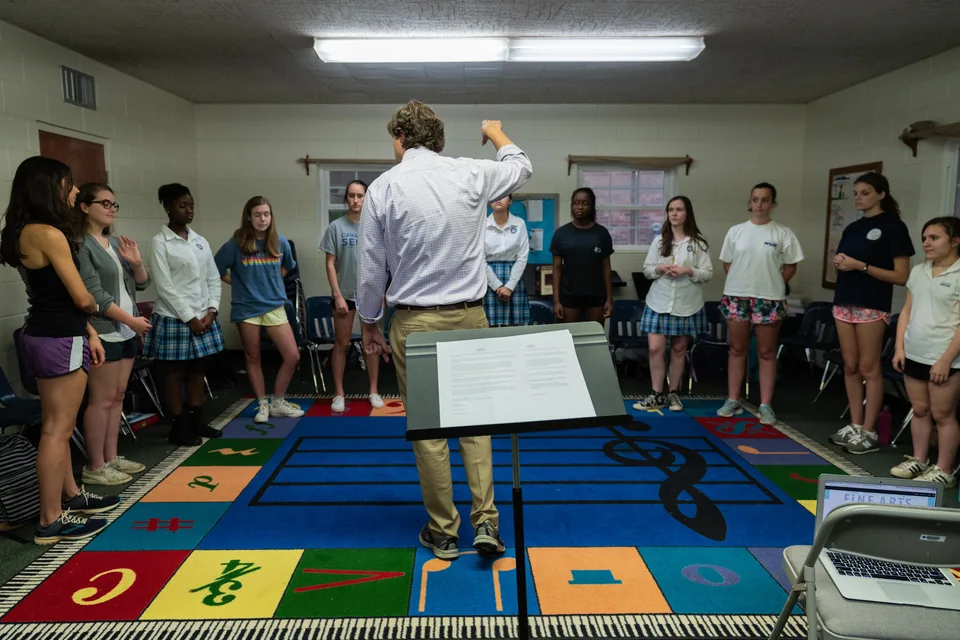
Learning to read, listen, and attend
Children learn letter-sound relationships, practice handwriting and arithmetic, listen to stories, and recite short poems.
Curriculum
Children will read, write, and study mathematics, history, science, and the arts, with teachers guiding each stage of learning.
Oxford Classical Charter School is a Hillsdale College-supported founding effort. Learn about Hillsdale’s support.
The aim
Children need both knowledge and practice: books worth reading, problems worth solving, and teachers who help them understand.
“Non multa sed multum.”
Pliny the Younger
An American classical education
Oxford Classical will offer a content-rich American classical course of study. Students will encounter the wisdom of the classics alongside the study of mathematics, the natural world, history, and the arts.
We want children to read with understanding, express an idea clearly, examine evidence, and take pleasure in learning. Lessons will build from the early foundations toward more demanding study.
Foundations first
In the early grades, students need strong foundations. Oxford Classical’s K-6 program will emphasize reading, phonics, spelling, grammar, handwriting, writing, mathematics, history, science, literature, art, music, physical education, and habits of attention.
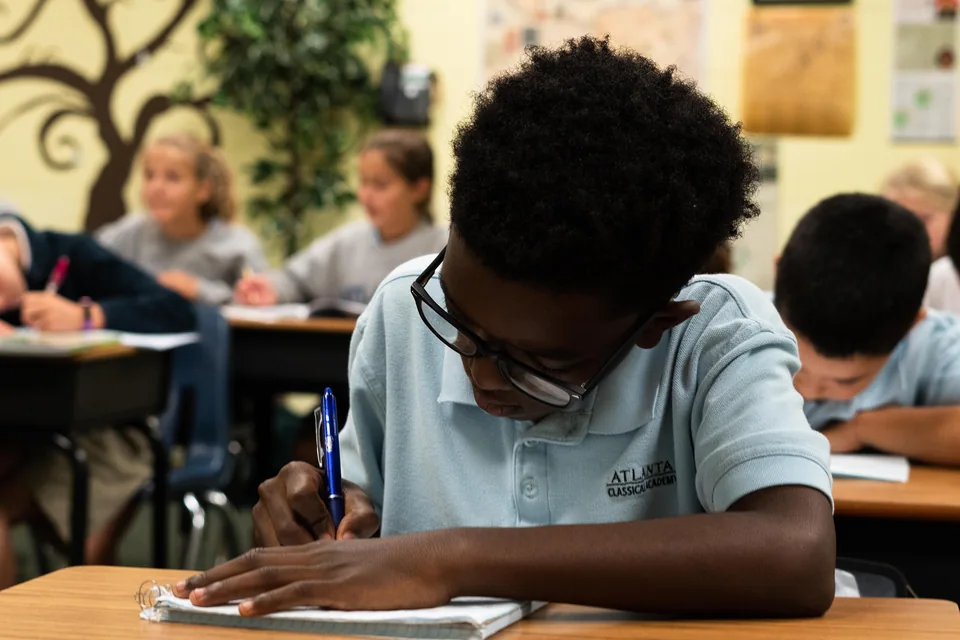
Children learn letter-sound relationships, practice handwriting and arithmetic, listen to stories, and recite short poems.
Children read increasingly demanding books, write organized paragraphs, explain arithmetic, and discuss what they have learned in history and science.
Students develop longer compositions, solve multi-step problems, examine causes and consequences in history, and record scientific observations.
What students study
Students will study the liberal arts and sciences together, building knowledge and skills across subjects.
Strong foundations in phonics, spelling, grammar, handwriting, literature, composition, vocabulary, and oral expression.
Accuracy, reasoning, number sense, scientific knowledge, disciplined observation, and careful problem solving.
The story of America and the wider world, taught with chronology, memory, place, cause, consequence, and civic responsibility.
Stories, poems, speeches, and serious texts that cultivate imagination, moral judgment, language, and love of learning.
Beauty, skill, discipline, movement, teamwork, and appreciation for the artistic and musical inheritance students receive.
Telling the truth, keeping commitments, listening respectfully, and persevering when work is difficult.
Academic expectations
Students will complete daily work at home and follow a language sequence that grows with them.
Students will have daily, age-appropriate homework to reinforce classroom learning. Early assignments may include reading and practice with foundational skills; later grades may include longer readings and essays. The workload will vary by grade.
Students will study Spanish in kindergarten through grade 5, Greek and Latin roots in grades 4 and 5, and Latin Ia in grade 6. As we add later grades, students will continue with Latin Ib, Latin II, and Latin III in grades 7, 8, and 9.
A day in the classroom
A poem recited together. A problem worked out on paper. Time outdoors with friends. Our third-grade program will bring learning, practice, and play into each day.
Children will recite poems and practice reading and phonics with a teacher. In mathematics, they will work from concrete examples toward written problems, explaining how they found an answer.
A classic read aloud will give children a story to discuss and sentences to study. Outdoor recess and lunch will make room for play, conversation, and friendship.
History and science will bring stories from the past and close observation of the natural world. Spanish, art, music, and physical education will vary by day, with time for recitation and cursive handwriting.
Illustrative school day. The Headmaster will set the daily sequence and bell times.
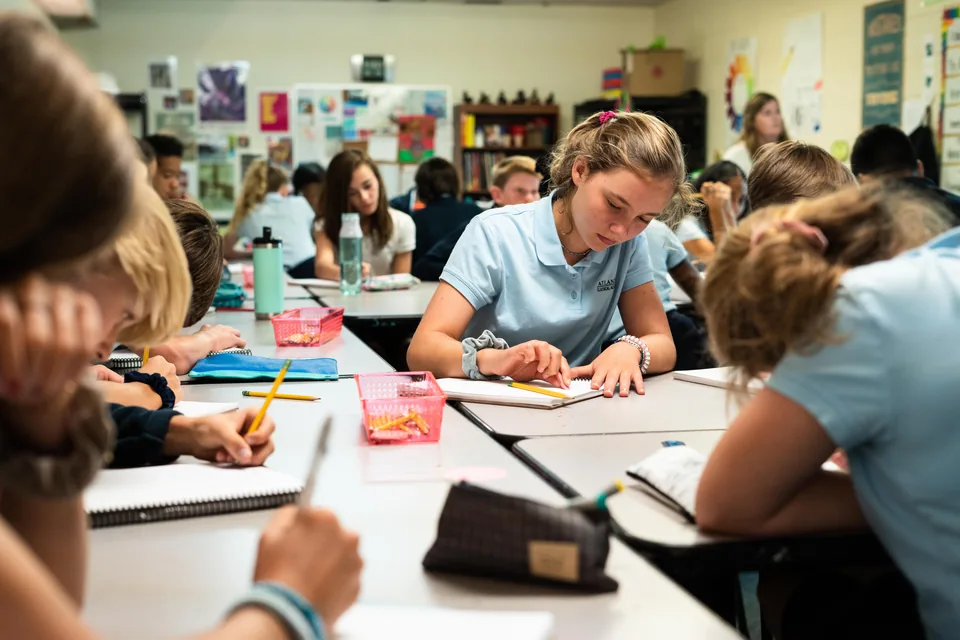
Students will wear uniforms. Classroom learning will center on teachers, books, discussion, and written work rather than personal devices. Required assistive technology and accommodations will remain available.
How students learn
Long-term academic vision
We will grow from K–6 toward a complete K–12 course of study. Each grade will prepare students for the next stage of learning, so that knowledge, skills, and character grow together over time.